



Donor-advised funds are a major reason I have such high expectations of philanthropy following AI IPOs. Money in these accounts can only be distributed to charities, and so cannot be repurposed if donors later change their minds.
Owing to a generous matching scheme and the altruism of its staff, Anthropic employees are believed to have committed as much as $60bn to DAFs. This means there is an unusually high ‘floor’ for the amount of giving that can follow, if these shares become liquid.
However, DAFs are also a significant reason that this money may have no impact at all. I think some of these donors should consider using their wealth to reform DAF law, and that this is an extremely high-ROI opportunity.
What is a donor-advised fund?
Donor-advised funds (DAFs) are accounts sponsored by a public charity that allow donors to get a tax deduction when they donate money or other assets, in return for restricting the proceeds to charitable purposes. Donors can then hold this wealth in the account, granting it out to public charities on their own timetable.
This can be very useful. Someone who sells a company, or whose shares become liquid in an IPO, has one enormous spike in income or capital gains. If they intend to give the proceeds to charity, the only way to avoid tax on that portion is to give it all to their grantees in the same tax year.
A DAF lets them take the full deduction in the year of the sale and give the money out over time, for example as multi-year support to grantees.
This benefits charities as well. A windfall in one year, with no guarantee of anything the next, is hard to use well.
I run two donor-advised funds myself at Ultra Philanthropy, where I advise AI-lab staff and other major donors on their giving, to enable donors to pool their resources and help mid-stage global health charities.
My issue is not with the mechanism itself - it’s with the lack of any deadline to spend the funds. (The Mid-stage Global Health Fund aims to commit everything it receives to a signed grant agreement within 90 days, but this is entirely self-imposed.)
Why is the donor-advised fund model flawed?
The problem is that DAFs have no rules forcing the donor to grant the money onwards from the initial sponsor to another charity. In fact, as DAFs allow you to appoint successors on your account, the wealth can even outlive the donor.
This leads to a bizarre situation, where donors receive an immediate tax deduction (in effect, a taxpayer subsidy for this money), without any obligation to use the money to make the world better. Whilst they can’t use the cash to buy a yacht or a pet tiger, they’re also not obliged to use it for any public benefit at all.
As Rob Reich, the Stanford political scientist who has written about this extensively, says: “the donor collects the full tax benefit the instant assets enter the account, and the law is entirely indifferent to whether a grant ever leaves it.”
How much money is sitting in donor-advised funds?
A lot, and it’s growing rapidly.
According to the industry’s own annual report, compiled by National Philanthropic Trust until 2024 and by the DAF Research Collaborative since, assets in DAFs grew from $78bn in 2015 to $326bn in 2024. Contributions into DAFs reached $90bn in 2024. Set against Giving USA’s total for all US charitable giving that year, roughly one dollar in seven went to a DAF first.
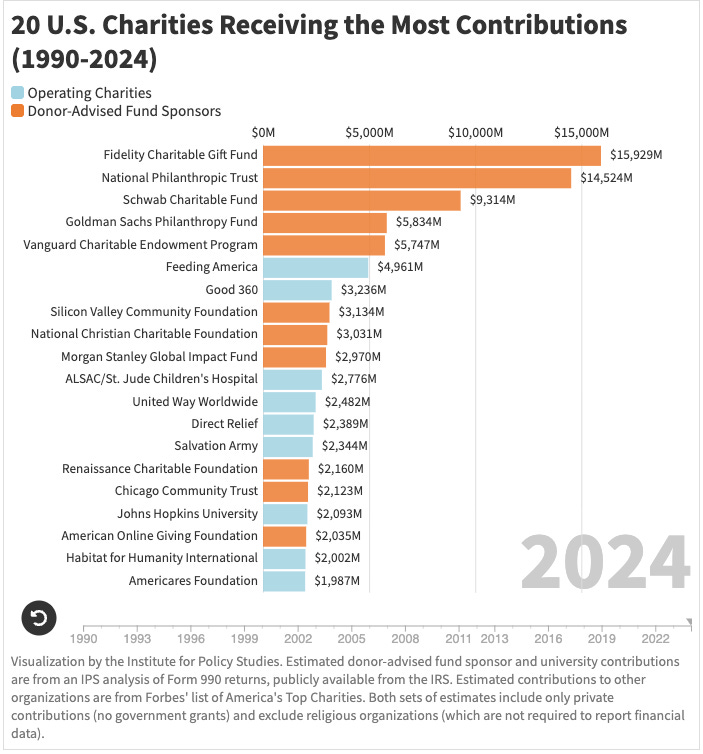
Helen Flannery from the Charity Reform Initiative at the Institute for Policy Studies has also shown that DAF sponsors were the five biggest recipients of charitable giving in 2024 among charities that publish their accounts, and eleven of the top 20 - so the parking of capital in DAFs, at least as a first step, is accelerating.
Defenders of DAFs will point to their disbursement rate, which is higher than that of private foundations, even though foundations must make a minimum amount of qualifying distributions each year by law. However, DAF payout figures are contested and probably overstated - whilst the industry reports that 25% of assets are paid out each year, the Institute for Policy Studies uses the IRS’s preferred formula to find that the median sponsor pays out closer to 10%. Indeed, even a study built on the sponsors’ own account data shows that more than 20% of accounts made no grants at all over three years and that the median account paid out only 9%.
These figures are, to me, unacceptably low. While a minimum payout from DAFs might not raise the median amount given (which already exceeds the legal minimum on private foundations), it would at least ensure that no DAF can sit indefinitely accruing investment gains, tax free, to no public benefit at all.
Why does this matter for Anthropic and OpenAI staff?
So should Anthropic and OpenAI staff put their equity in a DAF? Yes: it avoids taxation at the point of sale, allowing more to go to charity. However, they should also set a timetable for deploying this wealth, before it lands.
I recently outlined five bottlenecks between unlisted private shares and making grants. My concern is that DAFs offer time-poor donors, paralysed by choice and still working crazy hours, a way to put off their philanthropy indefinitely.
When I think about ways the Funding Anthropalypse could have less impact than hoped (a scenario I call the ‘Funding Anthropoflop’), the most likely failure mode is money sitting indefinitely in DAFs.
Reich makes a sharper version of this point. If you believe the next decade is decisive for how AI goes, then “philanthropic capital is a wasting asset”. A donor who believes that and parks their giving in a vehicle with no deadline is behaving incoherently.
Reforming DAF law would both avoid a scenario where the impact of the AI windfall is delayed and diluted, and move money to charities sooner across all the cause areas DAF holders favour.
Who benefits when money stays in donor-advised funds?
The sponsors that hold most DAF money are affiliates of Fidelity, Schwab and Vanguard, and donors can keep their own wealth manager running the assets inside the account. Fees are charged on assets under management, so every dollar granted out reduces the fees of those managing it.
The Institute for Policy Studies has documented firms pitching DAFs to advisers as a way to “maintain Assets Under Management”, and Flannery and Mittendorf found that national sponsors who stress donor benefits hold more assets because they pay out less, not because they take in more.
When the Treasury proposed rules in 2023 that would have taxed payments of a donor’s personal adviser fees out of a DAF, the industry pushed back hard, and three years on the rules remain unfinalised.
How could we fix donor-advised funds?
There have been valiant efforts to reform DAFs but none has been successful. The Initiative to Accelerate Charitable Giving brought the philanthropist John Arnold and the law professor Ray Madoff together with the Ford, Hewlett and Kellogg foundations to advocate for change, but it scored no legislative wins and its website no longer loads (the link is to an archived copy).
The bipartisan Accelerating Charitable Efforts (ACE) Act attempted to impose time limits on DAFs in 2021, and also to close a loophole where private foundations can hit their 5% disbursement minimum by transferring funds to a DAF controlled by their original donor (thus maintaining both the foundation and the DAF without necessarily providing a public benefit through either).
It didn’t receive a hearing or a vote in either the House or the Senate, after DAF sponsors and their trade groups spent $3m to defeat it (of an estimated $11m spent to influence DAF policy between 2018 and mid-2023).
With legislation stalled, various voluntary efforts have sprung up, such as #HalfMyDAF and DAF Day. However, their self-reported figures suggest that they have moved about $100m in six years, which is 0.03% of what sits in DAFs today.
Whilst this makes for grim reading, I believe that AI wealth can fund the solution (and thereby defeat one of its own biggest barriers to giving). I recommend that:
Donors join forces behind a policy campaign for a time limit on DAFs, as the ACE Act proposed, and fund it with a multiple of what the other side spent. The anti-reform lobby’s spending works out at roughly $2m a year, so I suggest donors target $20m a year. Passing things is harder than defeating them, so we need a significant cash advantage.
In the meantime, the same donors make a personal pledge to disburse a set percentage of their DAF each year. Reich suggests 20%, and this seems sensible to me: at average market returns and fees, that all but exhausts a DAF over 20 years.
Donors who haven’t yet received an AI windfall make this pledge now, before such an overwhelming amount of money lands in their account.
Even the weakest version of reform, a 5% minimum payout rule similar to that of foundations, would cost the typical DAF holder nothing. After all, the industry claims that DAFs already pay out 25% a year. If that’s true, a 5% minimum only touches the accounts that are warehousing their wealth.
On my rough sums, that weak rule alone would shake loose $3bn to $6bn a year from accounts that pay out almost nothing today. If we assume that the campaign costs $100m, over five years, and has a one-in-seven chance of passing a rule that then runs for a decade, the expected result is about $6bn moved to charities, or under two cents of campaign spend per dollar moved.
Even if nine dollars in ten of the money freed is spent indifferently, this would be one of the best returns in philanthropy.
If you hold AI equity in a DAF, set your allocation plan now, before the IPO makes the number too big to think about.
Jack Lewars is the founder of Ultra Philanthropy, an independent advisory that helps major donors give for maximum impact, and is the fund manager of its Mid-Stage Global Health Fund. He advises donors giving up to nine figures a year, and is Chair of Trustees at High Impact Athletes. Talk to him about your giving.
I used Claude to help structure my thoughts and to suggest improvements and flag gaps, as well as for proofreading; all views, final edits and primary drafting are mine.
Your recommendations only make sense if cost-effectiveness before the hypothetical deadline would be greater than after the deadline, even when accounting for (possibly unprecedented) investment returns. Why do you believe this? And with such confidence that you want to force donors to spend money based on your schedule?
I think historical track record of patient philanthropy looks better than imprudent philanthropy.