


Imagine you could live in one of two worlds in 2027.
In the first, Coefficient Giving is twice as big.
In the second, there are two Coefficient Givings of the same size.
Which seems better to you?
Having considered it for a while, I would choose the second world. Put plainly, two Coefficient Givings beat one twice as big. I think the potential $37bn+ AI windfall is a once-in-a-lifetime opportunity to achieve this, with significant long-term benefits.
Is effective giving too concentrated?
In my view, yes.
Coefficient Giving (and to a great extent GiveWell) have enormous influence and power within the ecosystem, by virtue of their size and track records. Coefficient Giving is also the predominant or only funder in some of its domains, such as funding the effective giving ecosystem and farm animal welfare.
The situation seems analogous to a monopsony in economics:
monopsony, in economic theory, is a market situation in which there is only one buyer... Although cases of pure monopsony are rare, monopsonistic elements are found wherever there are many sellers and few purchasers. (Encyclopedia Britannica)
You could argue that there is in fact a diversity of funding in some cost-effective cause areas. For example, in AI safety, there is Longview Philanthropy, the Survival and Flourishing Fund, Astralis, the AI Safety Tactical Opportunities Fund etc.
In global health, there is the Gates Foundation (granting roughly 20x more than GiveWell and 8.5x more than Coefficient Giving each year); the remaining bilateral and multilateral funders; and a large number of smaller foundations (Mulago, CRI, WAM Foundation, DRK etc.). You could therefore also claim that the global health landscape is sufficiently diverse.
However, Coefficient Giving outsources a substantial amount of its global health grantmaking to GiveWell - around $1bn to date, and $175m for 2026 so far. It’s therefore not really accurate to describe GiveWell as a counterweight to cG - it could even be considered an extension of it.
More to the point, I think the true test of over-concentration is not just the number of grantmakers in a field - it’s also their size and, more importantly, the amount grantees rely on them. In AI safety, for example, Coefficient Giving gives substantially more, and in almost all cases at least an order of magnitude more, than any other actor. In combating factory farming, it is widely estimated to be the largest funder globally, and in supporting the effective giving ecosystem it is essentially the only funder of note.
Across all cause areas, it is often true that there is no other funder who could step in and become a grantee’s majority funder if the main one walked away.
This, to me, is the true test of over-concentration, and it seems true of both Coefficient Giving and GiveWell, for a large number of their grantees. It is also not just theoretical - it is something that Coefficient Giving’s grantees themselves are concerned about.
In short, Coefficient Giving and GiveWell are exceptionally important to the majority of their grantees, in ways that cause significant risks to the grantees, the ecosystem and the problems we are trying to solve.
What’s wrong with one dominant funder?
To some extent, the answer to this is just ‘read about power concentration’. However, I observe at least five major issues with the current situation.
The first is how dependent grantees are on one organisation for their financial health. The decision of a single program officer, formed under uncertainty, can virtually dictate the grantee’s survival. This is unduly risky for the grantee and also has unwanted second order consequences. For example, I have literally been in strategy meetings where organisations have asked “what will Coefficient Giving think of that?”
The second is that the blind spots of the organisation and individual grantmakers can become significant failure points. Even the very best program officers (and Coefficient has many outstanding ones) are also human, with biases, limited hours in the day and imperfect judgement. Especially in areas of high uncertainty, it is incredibly helpful to have grantmakers who can step in if another can’t or won’t. And, while dominant organisations may try to hedge internally against their own missteps, I think it is much easier to do this when the decision-makers are separated structurally. That is, several smart people thinking independently about an issue in different organisations are more likely to hedge effectively than the same smart people in the same team or office.
(As an aside, an ecosystem with a diverse set of large funders is also more attractive to top talent, versus one where there is a ‘party line’ and power is concentrated in a single funder. This will likely be relevant if we want to attract a lot more people to work on causes we care about and increase our ability to deploy money well in these fields, something I intend to post about in the future.)
Third, a single dominant funder is also a single point of failure. We are currently all-in on Coefficient Giving and GiveWell’s reputations and assets. We already saw how incredibly damaging it was when the FTX Foundation collapsed and it was only a relatively small fraction of the ecosystem at the time. I am in no way suggesting any malpractice at either organisation - but I am uncomfortable with relying so completely on their continued good judgement and lack of scandal.
Fourth, it is bad for grantees if a single funder tries to do the majority of grantmaking in a given field, because they are very unlikely to be well-suited to every type of grant. Trying to assess $100m grants alongside $100k seed grants is almost never the right option, because the decision timelines, risk tolerance, due diligence and opportunity costs are completely different at different scales.
At the moment, we expect GiveWell to fund seed grants, mid-stage grants, USAID-collapse-response grants and things at massive scale - but this leads to numerous issues, such as small organisations reporting substantial delays in being evaluated, when they need a rapid review for a grant before their runway expires.
You can instead imagine a pipeline of seed funders and incubators, followed by mid-stage funders who can underwrite growth, before GiveWell funds the best things at serious scale. And this is without even considering that some grantees will have constraints that stop them taking money even from a funder perfectly suited to their stage of life, for example if they want money that is politically-aligned with their other supporters.
Finally, monopsonies also have a dominant function in shaping the market in which they operate. This creates a dominant view of what gets evaluated in the first place (cause areas and organisations), and smaller organisations usually follow their assessments. Unless we assume that their judgement is perfect, and that big organisations can adapt at speed when the situation evolves, this is sub-optimal.
Can GiveWell and Coefficient Giving absorb the windfall?
The two most dominant organisations in the space are making concerted efforts to grow quickly. Both are hiring fast and both are specifically focusing on high-absorption options to deploy more money quickly. They are also outstanding grantmakers and some of the only places with track records of handling hundreds of millions in grants. You can see the attraction for time-poor donors, looking for a safe place to give.
However, the scale of the Funding Anthropalypse is likely to exceed their capacity, even if that capacity increases significantly. Last year, GiveWell regranted $418m, and Coefficient Giving over $1bn. Even with the most aggressive scale-up plan imaginable, it seems unlikely to me that either organisation can even 5x its grantmaking in the next 24 months, and we may be talking about sums far in excess of the $7bn in grants that this would imply ($2bn for GiveWell and $5bn for cG). As an incredibly rough rule of thumb, I am sceptical of any large organisation claiming it can more than double year-on-year, which would imply a ceiling of $2.8bn.
Coefficient themselves acknowledged this bottleneck recently and others have made compelling arguments about an upcoming logjam. It’s also notable that even the Gates Foundation, arguably the best-resourced foundation in history, took roughly 25 years to ramp up to its current annual payout. Scaling up grantmaking is simply very hard to do quickly.
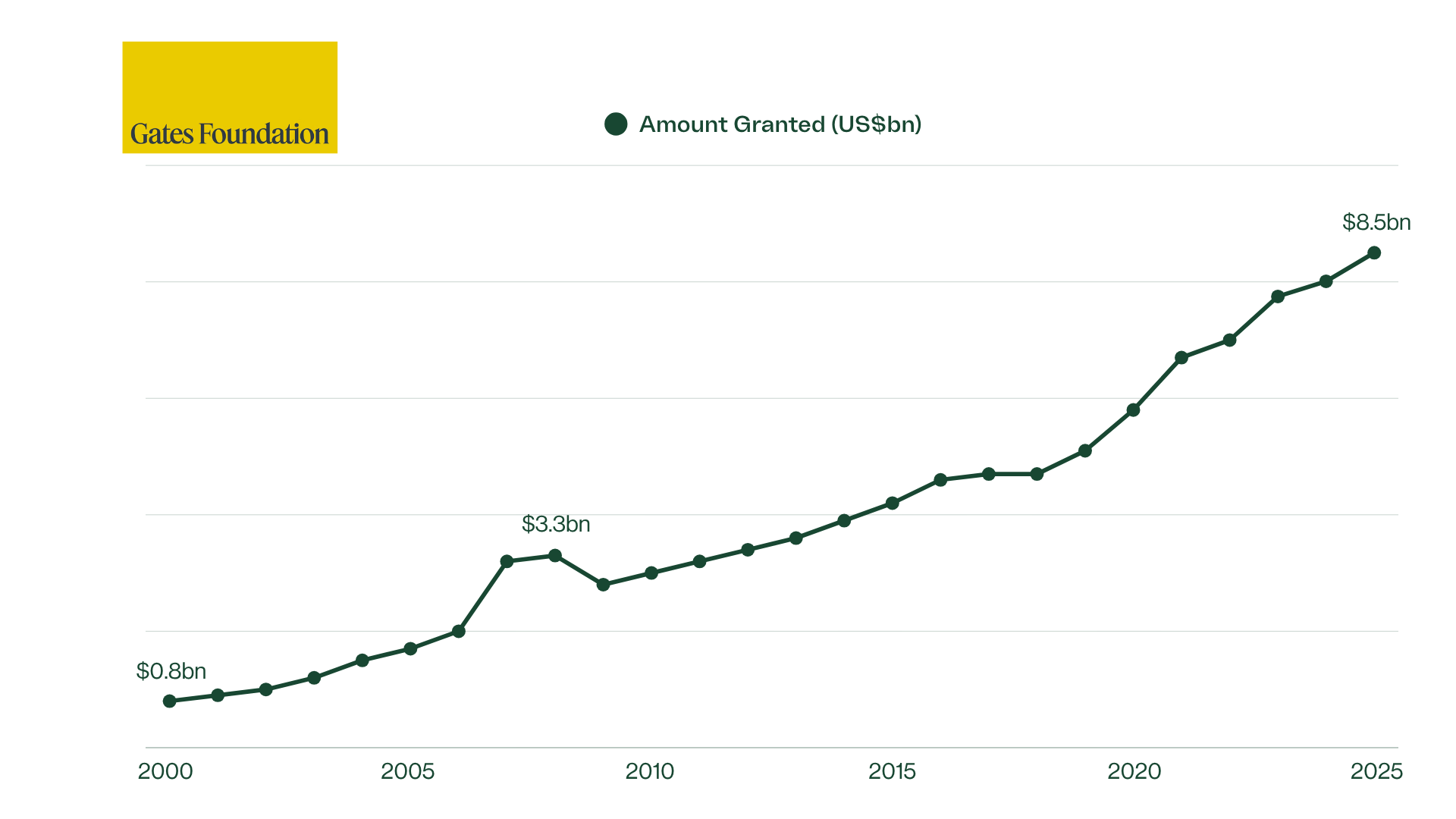
If the Funding Anthropalypse gives more to these two organisations than they can deploy, the most likely outcome is that this money sits on the sidelines for a long time. This is, in my view, a very bad outcome, given that global health has seen a global retrenchment; meat consumption per capita is rising; and many in and around the frontier labs expect very short AI timelines.
Of course, if you are completely ‘time-neutral’, this may not matter to you. I do also think it’s very difficult to judge exactly when and how much to spend now, versus saving capital for potential future opportunities, especially if you think you would need to lower your bar to make grants today. I expect we can all agree, however, that impact shouldn’t be constrained solely by a lack of grantmaker capacity.
Zooming out, this sort of difficult question is the whole point: I think capital sitting in a queue for years would be very bad, but I might be wrong, which is exactly why we want a diversity of decision-makers!
Lastly, even if both organisations defeat my predictions and scale up hugely, this somewhat solves the absorption problem; it only makes the concentration problem worse. So two Coefficient Givings would still beat one, even if the original is twice as big.
Could doubling Coefficient Giving be better?
Although I have come to the firm conclusion that we need more Coefficient Givings, there are strong arguments against my position.
The process of establishing new massive grantmakers will be really messy. It will likely start a talent war, as senior grantmakers are rare and reportedly hard to hire, so new organisations may just poach from existing ones.
Equally, setting up new foundations might not help epistemic diversity much if they just hire from a homogenous talent pool with the same views. However, I think the contention that the only smart, talented people are those already known to or within Effective Altruism doesn’t survive scrutiny, so there is plenty of potential to hire excellent people with diverse viewpoints and significant expertise. For one thing, about 260,000 aid professionals lost their jobs recently, and some of them are already doing excellent things that look very cost-effective.
We should also expect the quality of grantmaking at less experienced foundations to be worse in the short-term. On a pure cost-effectiveness basis, it is likely that GiveWell and Coefficient Giving can deploy money today with the most expertise, experience and analysis of anyone in the space. You also lose efficiencies of scale if you set up multiple organisations to move the same amount of money. The trade-off in both cases is between short-term and long-term consequences.
The coordination costs to multiple actors can also be steep. For example, it is not unheard of for two grantmakers to write large cheques to the same organisation, thus double-funding it, and avoiding this is a cost to both funders.
Maybe most concerning, there is a danger of empowering harmful grantmakers. This is a version of the unilateralist’s curse: when several funders can each act alone, it only takes one - the most optimistic - to back a project. The more independent funders there are, the higher the chance a harmful project finds its single most enthusiastic backer, even if most funders would have said no. This is particularly concerning in AI safety, where you could easily imagine someone accidentally supporting something harmful.
This objection is real and serious. However, this seems to argue for a handful of large, professionally-run funders, but not just one. It’s not obvious to me at all that a single dominant grantmaker is immune from making a harmful call - indeed, the risk of this seems quite acute.
In addition, in a practical sense, we are probably talking about fewer than fifteen peer competitors (say, a foundation for each of Anthropic’s co-founders and significant growth from Longview, AISTOF etc.). There simply isn’t enough money to found a hundred unilateral Coefficient Givings, and a small number of high-quality grantmakers is better-insulated from the curse than hundreds would be.
Lastly, the original paper lays out several remedies, none of which is to empower single decision-makers. Instead, it argues for a principle of conformity (pages 8-9) when dealing with unilateral decisions, and also for judicious information-sharing. A handful of funders who compare notes are barely unilateralists at all; a lone funder, with no peer to check it, is the one actor who can never be talked down.
Ultimately, I do not believe that any of these concerns outweigh the downsides and risks of the status quo, and I think this is a once-in-a-generation chance to fix it.
How has this played out before in global health?
Probably the most famous example of consolidation is Warren Buffett. When he made his 2006 pledge, he committed the bulk of his giving to the Gates Foundation, rather than setting up his own thing. This was widely lauded as an example of putting impact before ego, as it gave the Foundation significantly more resources, without any extra overhead.
I think this is really a cautionary tale, however. If Buffett had set up a similar foundation, of similar size, it would have reduced concentration and increased epistemic diversity. It would also have insulated the ecosystem better against scandal, potentially avoided the frustrations some grantees have with the single foundation, and the Gates Foundation could still have achieved its grantmaking to date from Gates’ own fortune.
It’s also notable that Buffet has since changed his mind, first excluding the Foundation from his legacy, and earlier this month excluding it from his mid-year giving for the first time. Whilst I am not claiming that this was a move driven principally by concerns about power concentration, it’s interesting that the arrangement did not survive as intended.
Where can the next Coefficient Giving come from?
The good news is that even some of the strongest objections to diversity can be mitigated by choosing the right donations.
First, there’s no need to invent new mega foundations from whole cloth. There are many good mid-tier organisations that donors can contribute to, across a variety of cause areas. Most are deploying in the tens of millions and would provide significant value if escalated to the hundreds of millions. To name just a few already directing >$10m/year:
Longview Philanthropy (existential risk)
AI Safety Tactical Opportunities Fund
EA Animal Welfare Fund (animal welfare)
DIV Fund (global health)
Founders Pledge’s Global Health and Development Catalytic Impact Fund
Navigation Fund (multi-cause)
(This list is not exhaustive and is very loosely vetted on general reputation and places deploying >$10m/year. For more in-depth analysis, please get in touch.)
Indeed, although this isn’t a developed model, I think there is roughly a bellcurve-shaped distribution of size and risk-adjusted effectiveness. That is, at the lower end, funds need to grow or merge to have a significant impact - but once they reach the hundreds of millions per year scale, diversification is a defensible alternative, and at the billions per year, it’s essential.
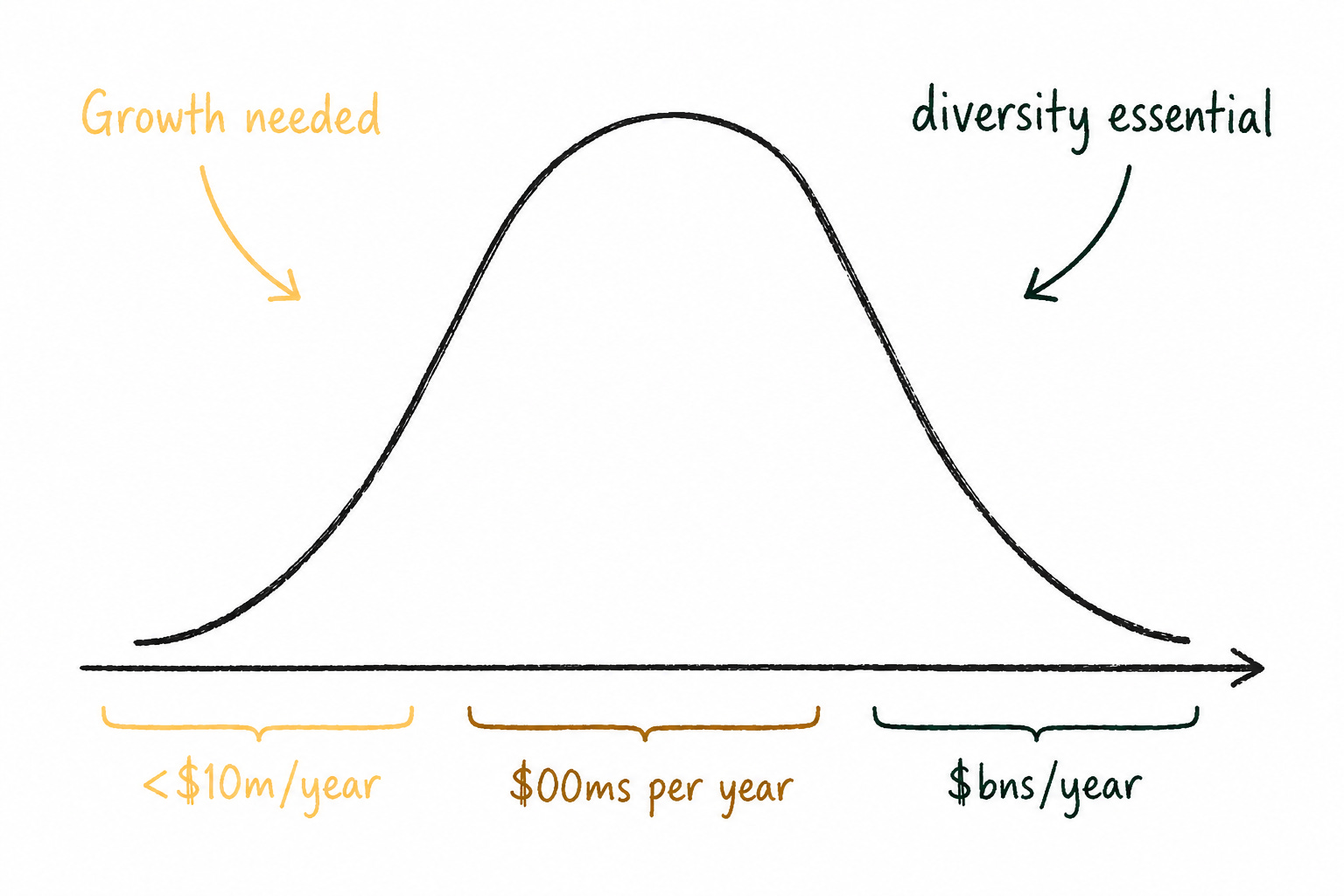
My own mid-stage global health fund is an example of this. At our present run rate of only $3m per year, we are hardly ‘solving’ the mid-stage valley of death in global health. Indeed, we can’t support even one late mid-stage organisation in a significant way. At $50m-$100m, however, we could be a major force for good, but we wouldn’t want to be the only player of that size. A world where we operate at that level alongside DIV Fund, Livelihood Impact Fund and others seems optimal.
I also want to be clear: I definitely do not want Coefficient Giving or GiveWell to shrink. They are tremendously successful grantmakers who have done an enormous amount of good, shaping entire fields for the better.
My answer is instead to create counterweights and coordinating peers, who can take the opposite side of 60:40 calls, diversify grantees’ risk, make grants on asynchronous timelines and fund things the others can’t, won’t or shouldn’t (such as 501(c)(4) activity, for example).
As Coefficient Giving put it themselves: “when external funders come to us for advice on giving, we are typically able to recommend funding opportunities that we believe are 2-5x as cost-effective as Good Ventures’ marginal AI safety funding.”
What should I do with my AI windfall?
If you are someone who expects to come into AI wealth, you can be an active part of the solution (provided you can see past the incessant noise about your philanthropy).
My strongest piece of advice is to diversify your own grantmaking plans. You have the luxury of being able to use outstanding grantmakers like GiveWell and Coefficient Giving, while also supporting a handful of other actors to grow and de-risk the ecosystem. You can do this whether you have $10m to give or $100m - and, indeed, at this scale, you might be particularly well-suited to supporting smaller funds and grantmakers alongside other donors. You might also effectively unlock matched giving, to augment your resources.
If you are a particularly large philanthropist, you have an even bigger opportunity to build something that might be a genuine counterweight to the biggest existing organisations. This applies most obviously to the companies’ co-founders, the OpenAI Foundation and the Long Term Benefit Trust at Anthropic - mathematically, these are the only places that can rival the resources of Good Ventures as actual peers. However, I think anyone contemplating over $100m in giving should give serious thought to seeding or building a new vehicle, at least with part of their resources and especially if they can do it with a few other donors of the same size. This is admittedly a marginal call at the nine-figure scale, and I would recommend reading these existing resources and sourcing bespoke advice before committing.
In general, deciding the right split between existing, scaling and new allocators is very difficult, and this is what advisors are for. As someone who runs an advisory and has a fledgling fund, I obviously have conflicts of interest here. Accordingly, I would discount the above appropriately, stress test the arguments and consider a range of advice.
For free advice on where to get help, including pointing you to others in the space who are better-placed than me, please get in touch.
Jack Lewars is the founder of Ultra Philanthropy, an independent advisory that helps major donors give for maximum impact, and fund manager of its mid-stage global health fund. He advises donors giving up to nine figures a year, and is Chair of Trustees at High Impact Athletes. Talk to him about your giving.
Thanks to Jakob Graabak, Olivia Kaye and Patrick Kaczmarek for their review, suggestions and feedback. I also used Claude to help structure my thoughts and to suggest improvements and gaps, as well as for proofreading; all views, primary drafting and final edits are mine.
Thanks for writing up this piece, Jack! I think this is one of the main questions we need to answer if we want all the money that might come online during the next few years to create real impact.
On the one hand, obviously CG is an exceptional place - the fact that they were able to identify future AI risks and engineered pandemics as top priorities more than a decade ago, when ~no other major philanthropic players were covering those topics, looks near-prophetic in hindsight. Animal welfare is another unusual bet where it looks like others might follow them in years to come, and even within more established fields like global health, they have often outperformed peers (hence the meme "Open Philanthropy strikes again"). So there's a clear case why new donors might defer to them as the default experts across many of these domains.
Even so, I agree with you that I think these philanthropic "markets" can benefit from more diversity of philanthropic intermediaries (I'm using this to refer to anyone sitting between the donor and the grantee, including both philanthropic advisors and also fund managers), and I agree with many of your reasons for it. Some considerations that are decisive to me:
- It looks like *founders* are going to be the binding constraint on many of the relevant philanthropic cause areas (e.g., AI governance, biosecurity, and nuclear stability - areas where I am currently working). So we should design our ecosystem by what would attract more and better founders. A more founder-friendly ecosystem would give top founders more leverage, translating in better terms (e.g., faster grant decisions, longer runways, clearer pathways to scaling up through future grants, and fewer strings attached with grants). A simple way to do this is by creating multiple separate funding sources which would then compete over the best founders.
- I think the simplest way to think of this is, if you believe something is good and that there should be a lot of it (with "it" e.g., being biodefense projects like PPE stockpiling and air purification technologies, or some other public good that the new donors are interested in) , then many independent decision makers should have the power to make it happen. There's a reason why the Renaissance happened among competing Italian city states, why the Industrial Revolution happened among competing UK merchants, and why most current frontier technologies are built among competing VCs in the Bay Area; that's just reflecting where founders have the easiest time finding a patron for their project.
- I think I emphasize speed and agility a bit more than you do. The world is going to change fast in the coming years, and grantmaker strategies will likely need to change with it. An ecosystem of independent decision makers can evolve at the speed of the fastest, most foresightful funder (though who claims that mantle will change over time). A monolithic ecosystem moves at the speed of the slowest bureaucratic procedure in the monolith.
- On the unilateralist curse, this is something I've also heard mentioned as an objection against more diversity in the field. As you say, many of the candidates for "Coefficient Giving 2.0" or 3.0 are existing players in the field that are well known to CG, and I don't think they have a track record of being significantly more reckless, nor that CG would have a hard time convincing them to be cautious in the most risky domains of their portfolio. This seems like an entirely solvable problem. I also think that as a philanthropic grantmaker, most of your portfolio should ideally not be so dual use/ knife-edge that a small mistake risks large harm; if that's the case, I think the portfolio is emphasizing the wrong things, and you should look for more robustly benign projects.
- On donation timing, I agree that it is a hard question. But I think it is bad if the question is decided by operational constraints, instead of value tradeoffs between current donations and future donations. *If* donors want to give now, there should be a way to deploy the resources now. The default deployment pathways look like they will saturate, which means now is a time to get creative about that. And personally I lean in favor of haste over patience - there's almost no historical issue (e.g.,, slavery) where people tend to think "that was solved too fast, the world should have waited a bit longer". That's probably a good heuristic today, as well. And for some issues, like AI safety, it looks like we are racing against a clock that's ticking very quickly.
- Additionally, more diversity in intermediaries would also give the donors themselves more "consumer choice". A broader class of intermediaries with a credible track record of scope-sensitive prioritization within these areas would let donors pick the intermediaries that are the best fit with their own values and theories of change. As such it reduces the market power of intermediaries in favor of donors.
Finally, a note on CoIs: I am currently a program manager at a smaller philanthropic advisory shop in this space, so my views are clearly colored by this and should be discounted accordingly (though the flip side of this is that I would also stand to lose market power from a more competitive intermediary market).
Two Gates Foundations at half the size would have probably been way way better than what we have now.
It’s awesome to see how Founder’s Pledge often does CEAs in a slight different way than GiveWell—and I think that’s such a good thing.
An ecosystem of big thinkers is so much better than just 1-2.
I’m so glad that Ren Phil exists.
The tension between the Big Bang/Mulago/Skoll world and the Charity Entrepreneurship/Givewell world has been really productive.
I think this is great.