

This blog also appears on VoxDev.
USAID’s destruction has precipitated the largest drop in overseas development assistance (ODA) in history. ODA fell 23% in 2025 and the OECD projects a further reduction in 2026.
Meanwhile, OpenAI and Anthropic have filed confidential paperwork for their Initial Public Offerings (IPOs). According to the Financial Times, investors expect Anthropic to list at around $2 trillion in October, the largest IPO ever.
Ordinarily, these events would be unconnected. However, an unusual share of this wealth is already committed to charity, and much of it could flow to global development. I call this collision the Funding Anthropalypse.
Why this IPO wealth is different
IPOs normally make money for individuals, not charities. Original Giving Pledge signatories, many of whom founded companies, are 283% richer since they signed the pledge and, of the Pledgers who have died, only eight out of 22 gave enough to fulfil their commitment.
Nonetheless, the seven co-founders of Anthropic have promised 80% of their proceeds to charity. Of course, they may not follow through – but even if the Giving Pledge statistics above make you sceptical, there are strong reasons to think this will actually be a philanthropic windfall.
Many Anthropic staff have also committed shares to charity, and the company has said it will match those contributions. Much of this equity has reportedly already been placed in Donor Advised Funds, helped by an extremely generous match for early staff (an extra three donated shares for every one they gave). This money can only legally be paid out to nonprofits. OpenAI has also put 26% of its stock into a foundation, which restricts what it can be used for.
So the amount donated will be somewhere between a very high floor (what is already legally destined for charity) and an even higher ceiling (the fulfilment of less-binding public pledges).
How much money will be donated?
The best-known estimate comes from Nan Ransohoff, in her article The Third Wave of American Philanthropy. This estimated $37bn per year of new giving, assuming 10% of the available capital is paid out each year.
I think it’s helpful to apply some discounts to this, however. First, this includes the OpenAI foundation, which is likely to be more US-centric than employee capital. Early indications are that much of this will be spent on AI-driven research and development in health, AI safety and causes that are either distinct from, or only partially overlap with, global health and development. I therefore exclude this money completely from my figures below.
Second, the timeline, commitment and cause areas of the Anthropic founders remain unclear.
However, if we concentrate only on Anthropic’s employees, Ransohoff’s model suggests they have $55bn-$110bn to give at the current post-money valuation of $965bn. At a $2trn IPO, this amount would more than double.
Given that many of these pledgers are committed Effective Altruists (EAs), we can also expect a sizeable chunk of this to go to global health and development. Various estimates over the years have suggested 45-55% of EA donations go to this cause area (one estimate here, another here).
We could adjust the figure downwards, because those EAs working in AI labs are likely to be disproportionately concerned with AI safety; but we could equally adjust it upwards because development can absorb a lot more funding than some other EA cause areas. The founders are a harder read: their public focus is AI itself, so the model assumes only 5-40% of their giving reaches global health and development, against 35-55% for employees.
Five bottlenecks to deployment
Money committed to philanthropy is not the same as money spent, and there are five key bottlenecks between pledging and deploying.
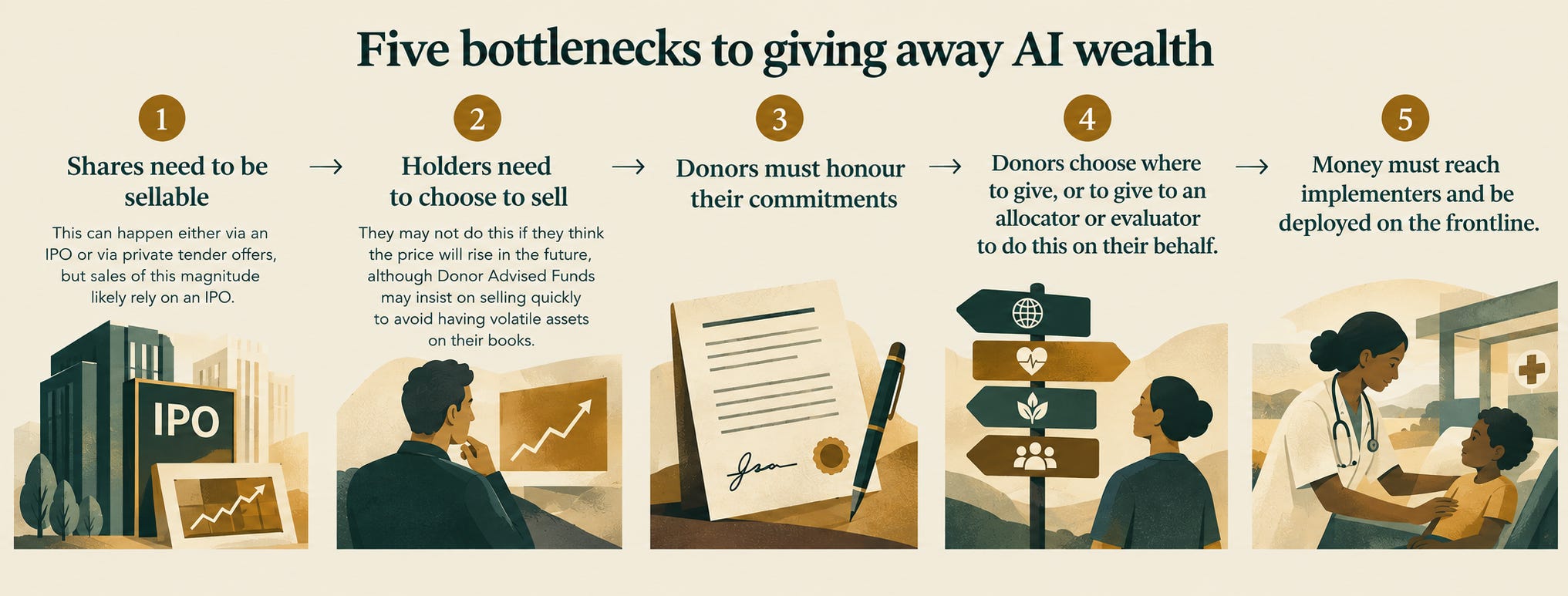
First, the shares need to be sellable. This can happen either via an IPO or via private tender offers, but sales of this magnitude likely rely on an IPO.
Second, the holders of the shares need to choose to sell. They may not do this if they think the price will rise in the future, although Donor Advised Funds may insist on selling quickly to avoid having volatile assets on their books.
Third, donors who have pledged to charity but not put a legal lock on the money must honour their commitments.
Fourth, they need to choose where to give, or to give the money to an allocator or evaluator to do this on their behalf.
Finally, the money needs to reach implementers and be deployed on the frontline.
Each of these stages will see some attrition, and it’s highly uncertain how much will occur at each stage. Accordingly, I built a model here that you can use to enter your own discounts.
Whichever way you cut it, it looks like a lot more money is heading to global health and development. My ‘mid-range’ scenario is:
$272bn committed to charity ($139bn from the founders and $133bn from employees);
Paid out at 10% of the holdings per year;
45% of employee contributions and 20% of founder donations going to development;
Creates $87bn for development, or around $8.8bn per year by 2030.
Assuming only 7-15% of available capital is granted out each year, my ‘bear, central and bullish’ scenarios are:
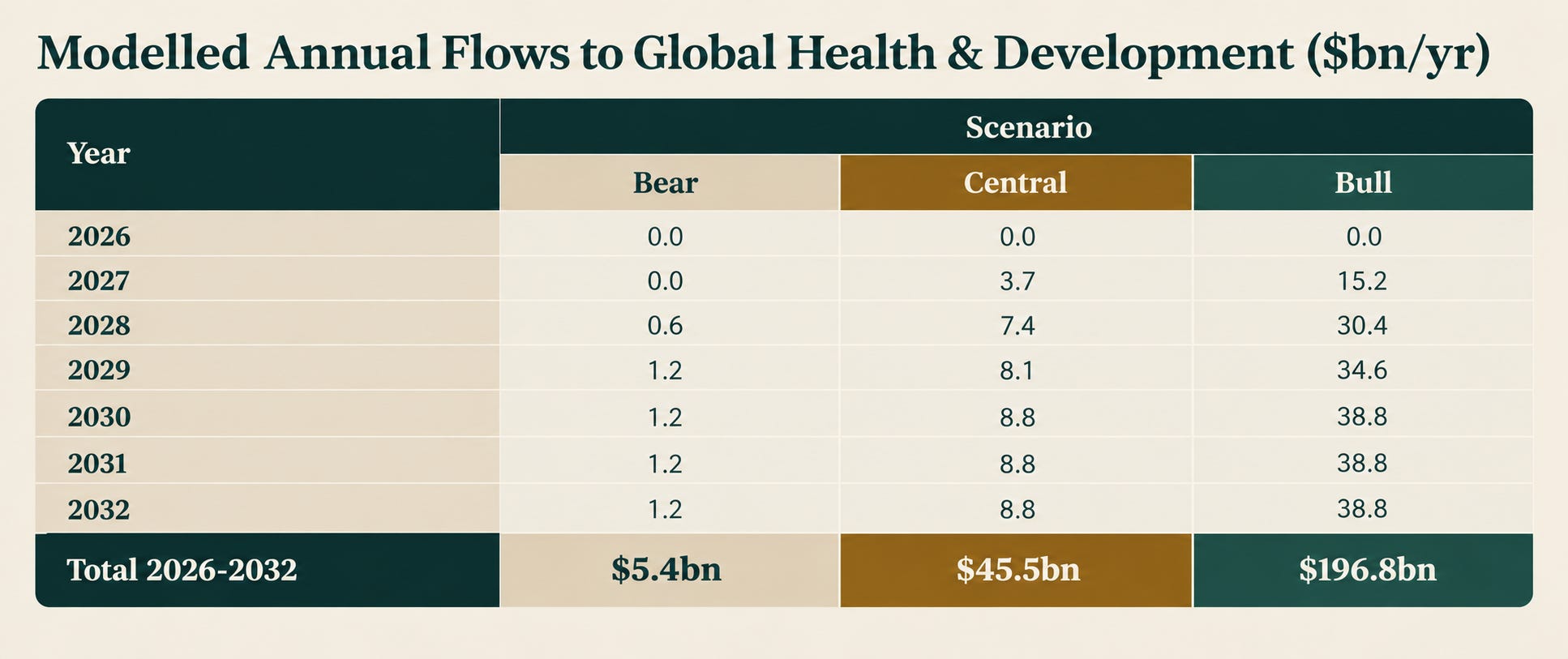
For scale, the Gates Foundation, the largest private funder of global health, pays out around $9bn a year. In the central scenario, these donors would be deploying almost as much every year, just to global health and development, by 2030. In the bull case, on the same timeline, we’d have approximately three more Gates Foundation-equivalent funders in a few years time.
What this means for development actors
This represents a huge opportunity, and a rare piece of good news amidst falling aid budgets.
The default destination for much of this capital will be GiveWell and Coefficient Giving, the pre-eminent cost-effectiveness evaluators, but their frames are broadening – GiveWell has begun investigating livelihoods interventions and Coefficient lists fourteen funds on its website, across a variety of themes. I expect them to broaden further as more capital becomes available.
There are also fields that individual donors may be interested in, but where no dominant player exists in the EA ecosystem: education in LMICs, AI deployment in global health, mental health, policy change.
In all cases, however, it is critical to speak the language of these donors. Anyone connected to EA is going to look for cost-effectiveness analyses, a solid evidence base (ideally Randomised Controlled Trials, although these aren’t always essential), strong monitoring and evaluation of implementation looking at outcomes and not activities, and usually an ambition to scale.
This may be anathema to actors who think differently about development, but it isn’t realistic to argue donors out of long-held convictions. The goal is to translate your work into their language, not to fight them over it. And, whatever you do, don’t just send frontier AI lab employees a cold email – they report getting up to 20 per week, and there are better ways in.
The good news is that more money and many new decision-makers mean there is more scope than ever to win funding from these donors. The cost-effectiveness bar for what gets funded is already falling and will likely fall further.
Any development organisation aiming to take advantage of this windfall should start work now. Anthropic’s IPO may come as early as October 2026 and restrictions on staff stock sales would then expire in the first half of 2027.
A reasonable plan of action would be:
Revisit your theory of change and monitoring and evaluation, to make sure you are capturing the right data to test your assumptions and demonstrate quality implementation.
Build or refresh a cost-effectiveness analysis – without it, you will struggle to compete.
Refresh the evidence base for your work - is the field well-established or still speculative? What’s the highest quality evidence you have for your own implementation? What further research could bolster either case?
Create a robust, costed plan to scale up, including your back office.
Start a conversation with trusted evaluators and intermediaries to see if they will recommend your work.
Any organisation that can execute these steps successfully has the chance to share in $8.8bn/year of new giving by 2030.
Jack Lewars is the founder of Ultra Philanthropy, an independent advisory that helps major donors give for maximum impact, and is the fund manager of its Mid-Stage Global Health Fund. He advises donors giving up to nine figures a year, and is Chair of Trustees at High Impact Athletes. Talk to him about your giving.
Thanks to Oliver Hanney, Managing Editor at VoxDev, for his help with the draft. I used Claude to help structure my thoughts and to suggest improvements and flag gaps, as well as for proofreading; all views and primary drafting are mine, and final edits are mine and Oliver’s.