


“What is the most common mistake donors make?”
This is one of the questions I get asked most as a donation adviser. Often, I say that it’s risk tolerance.
Many donors have risk backwards. They hold the money they plan to give at close to maximum risk, often in a single company’s stock, then give it away at close to minimum risk, backing only the most heavily evidenced organisations.
Getting it the right way round means working at three levels: de-risk the wealth that funds your giving, diversify your grant portfolio, and take more risk inside it.
What do most donors get wrong about risk?
Candidly - almost everything. The majority of individual donors are distributing risk carelessly across multiple axes.
Take the distribution of risk between wealth and grantmaking, for example. Many donors are taking extremely large risks with their capital, whilst only giving to massive organisations backed by 24 randomised controlled trials (RCTs).
That’s two risk decisions taken with the same money, sometimes without noticing either.
AI equity holders are a clear case. Many are committed to the most rigorously evaluated forms of giving, but hold their wealth in a single stock.
More than $1trn came off semiconductor and AI hardware stocks in July.
If your wealth sits in one AI company - public or private - the market that prices these companies just moved a long way. You should therefore be thinking actively about how much risk you’re willing to take with these funds, and, as I’ll argue, consider demanding less certainty before giving them away.
How much risk should I take with my charitable giving?
In short: more risk than you (probably) take now at the grant level, and less with the wealth itself.
Most donors should give their core funds to low-risk, evidence-backed giving; commit a genuinely risky bucket to funds that make enough grants to survive a high failure rate; and keep a small slice for direct bets. As a starting point, this could be 70% to the core, 20-30% through risk-tolerant funds and 0-10% directly to moonshots.
On the wealth side, Anthropic staff had the chance to sell some of their shares in April. However, buyers were left unable to purchase their target amounts, as staff chose to hold on to their equity. In this instance, the bet has paid off handsomely - the company has since been valued at $965bn post-money.
This is, however, an extremely risk-tolerant approach. Many staff at frontier labs hold most of their wealth in the undiversified volatile stock of a single company.
Single stocks are a wild ride. Hendrik Bessembinder studied every US common stock since 1926 - around 26,000 of them. Most returned less over their lifetime than one-month Treasury bills, and the single most common lifetime outcome was a complete loss. Just 4% of companies account for the entire net gain of the US stock market in the same time period.
Anthropic may well be one of the exceptions that does extremely well. But you don’t need a failure to get hurt - as July showed, concentration means the money you’ve earmarked for giving could move a long way in a few days.
Much of this concentration isn’t chosen - lock-ups and sale windows can put constraints on donors. At the margin, however, staff are choosing: whether to sell into a tender, how much to diversify when they can, and when to start giving.
What would happen, meanwhile, if a donor took these sorts of risks in their grantmaking? In my experience, most would quit after a year.
This isn’t because donors don’t understand variance - many donors built their money through judicious risk-taking, either in companies they founded or by directly trading volatile assets. Instead, I think it’s because a failed grant hurts more and is more embarrassing than a failed investment. It can be very difficult to explain that a grant did not succeed, whether to your spouse, your co-founders, the friend who recommended the nonprofit or to yourself. The reputational and emotional cost often outweighs the financial loss.
In addition, donors don’t swiftly cut their losses. Venture funds drop failing bets quickly, guided by clear pricing signals. Donors don’t get any signal without robust grant monitoring - and they don’t want to admit a mistake or let down a favoured nonprofit anyway. So the failing grant keeps its funding.
It’s less ‘costly’ overall to keep giving money to a charity that isn’t succeeding than it is to change direction. Accordingly, most donors act in a way that is inconsistent with rational risk tolerance.
How should I spread risk across my giving?
Donor confusion often starts with conflating different types of risk.
Risk at the grant level can sit in at least three different places:
Intermediary risk. Using an intermediary (a grantmaker, evaluator or fund) that has a limited track record, even if it works in an established area.
Project risk. Backing an unproven intervention, even if you or your intermediary is an established grantmaker.
Team risk. Backing people who haven’t executed before, even if the thesis of the intervention is solid.
Risk increases as you go down this list. You can therefore manage your exposure by making grants that are spread between these tiers, or even avoiding some of them altogether.
For example, you could separate a chunk of your capital for risk-tolerant giving, and then put most of it into backing a couple of new-ish funds in a well-established area, where newer teams can lean on best practice from established peers. (Conflict of interest disclosure: I run Ultra Philanthropy’s Mid-Stage Global Health Fund, exactly this kind of vehicle, so discount appropriately. I can confidently recommend several others without conflict, though, like DIV Fund, the EPIC Air Quality Fund and D-Prize.)
You could then use the final, say, 10% of your giving to back a range of experienced operators trying new moonshots - maximally risky grants, not diversified at all at the grant level and with little information to predict the outcomes, but at least following a tried-and-tested venture model. Coefficient Giving’s hits-based giving rule is to back people with excellent records, even when the approach itself is unproven.
When I talk to donors about their approach, they often say that they have extremely high risk tolerance in their giving. They then say that they made fewer than ten grants in the past year, all directly to frontline projects.
These things are incompatible. Roughly two-thirds of venture financings return less than the capital invested, and only about 4% return more than 10x, which seem like reasonable proxies for grantmaking. If you make a single-digit number of grants per year, at the failure rate of true hits-based giving, you’ll probably fail with most of them.
Five direct-to-project grants is not a portfolio - at a 4% hit rate, you have an 82% chance of achieving no big hit at all.
You might not have the time or the expertise to vet large numbers of direct grants per year. That’s where intermediaries like evaluators and pooled funds can help - you essentially ‘buy’ their diversified risky portfolio, rather than building your own. Large enough funds can make tens of grants per year - even well over a hundred - without losing their nerve or running out of vetting capacity.
Capital matters too. AI staff may be tied to preset sales schedules and extended lock-up periods, forcing them to build a portfolio over time, as money arrives in a steady drip of (relatively) smaller amounts.
This makes the riskiest kind of grant - seeding a new venture from scratch with meaningful start-up capital - hard to do alone, even if the most senior staff could still free up substantial amounts each year.
One solution is again to pool your funds with other donors, either via a fund or a donor circle. This allows small donors to club together to create a bigger funding lever.
How should I balance evidence and risk in my donations?
Recent events should tilt the balance towards risk. Effective giving has historically pushed the other way - towards evidence-backed opportunities that give donors much more confidence than the average grant.
These opportunities are likely to be amply supported in the Funding Anthropalypse, though. Indeed, as far back as 2016, Coefficient Giving (then Open Philanthropy) made this point when talking about hits-based giving:
If an idea is backed by strong evidence, expert consensus, and obvious appeal, it’s probably already well-funded.
Coefficient Giving
If that was true then, the evidence suggests it is much truer now. GiveWell has lowered its funding bar from 8x to 6x its benchmark, which it estimates may result in $90m in counterfactual grants. This is the direct result of more available funding for higher-confidence global health bets, and that was before its commitment from Coefficient Giving increased to $1bn.
Many donors should respond by taking more risk.
Although GiveWell still believes that it will find many unfunded opportunities, and Coefficient Giving warned that its increased commitment shouldn’t be seen as a steady state, money is currently arriving at the safer end of grantmaking faster than opportunities are being discovered.
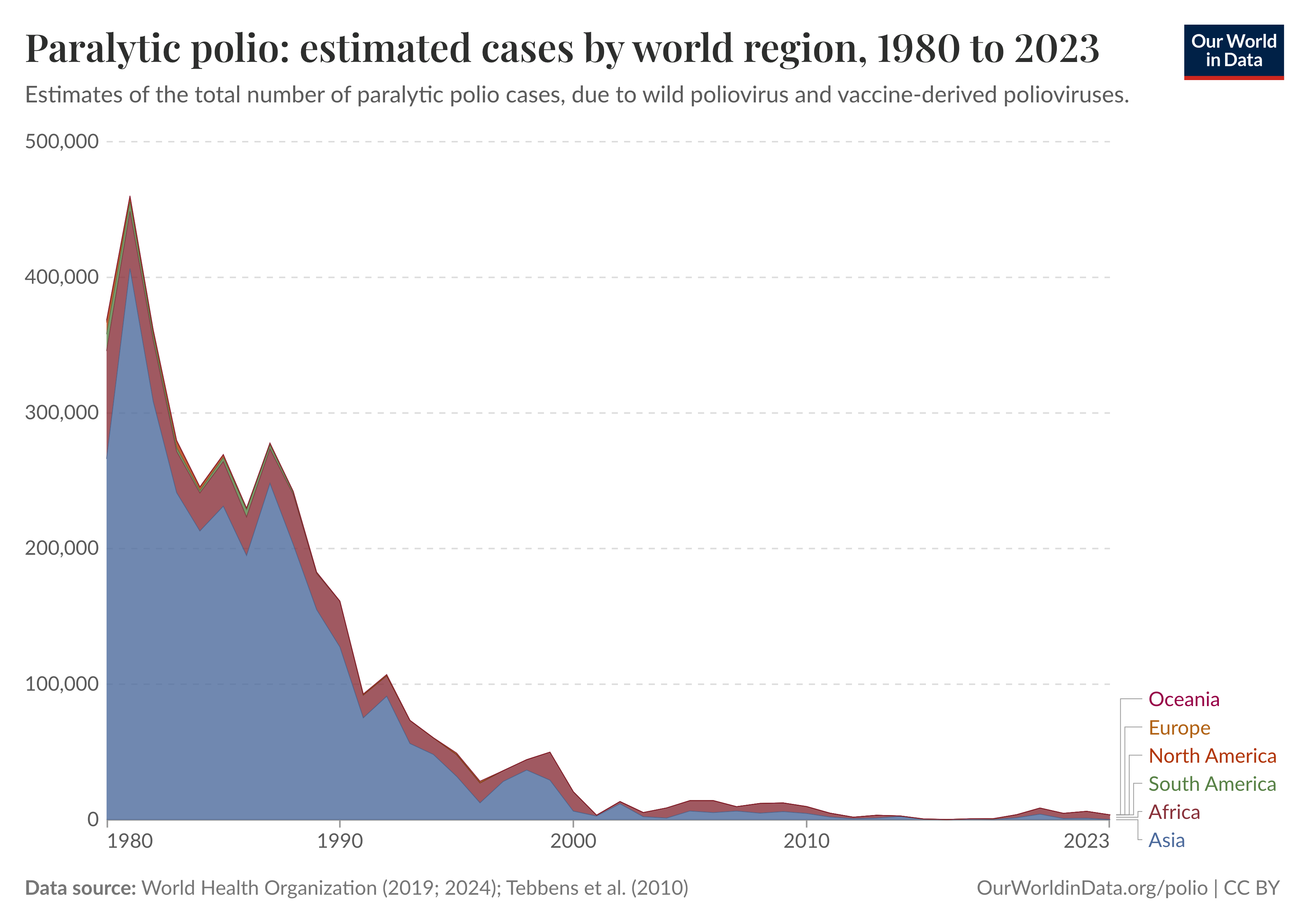
The answer isn’t necessarily to switch entirely to hits-based giving - it’s to increase your risk tolerance to take account of the new facts on the ground. If you score even one hit, the impact can be enormous - see the polio vaccine. You just won’t know in advance which bet will win, and so need to spread your bets appropriately.
Do charities need RCTs before I fund them?
Usually not - look for an intervention that has been tested by an RCT, but don’t necessarily require that an organisation has measured its own implementation this way.
Donors who want to take more risk need to match the evidence appropriately to the speed and type of intervention. Although RCTs are excellent evidence of effectiveness, they have significant drawbacks, including prohibitive costs (often several million dollars), years-long delays in producing results and sometimes being the wrong way to measure the intervention, full stop.
Jonathan Jackson is CEO of Dimagi, a large and respected global tech-for-good social enterprise (disclosure: I recommended that a donor make a five-figure grant to Dimagi earlier this year). He told me recently about an RCT of an AI-driven mental health intervention - by the time the programme was halfway through the data collection period, the LLM it relied on had been retired, making the study impossible to complete.
This doesn’t mean we have to give with no evidence at all. The alternative is proper monitoring, evaluation and learning plans, calibrated to the size and type of intervention. These include outputs, outcomes and accurate costs, measured against targets set in advance, alongside probabilistic bets on success. If housed within a clear theory of change, this shows whether a project is on track without a randomised study - and lets donors accept a grant’s risks with clarity, and offset those risks elsewhere.
I’m expecting an AI windfall. What should I do?
First, you should seriously consider diversifying your wealth. At present, the overwhelming majority of your philanthropic funds might be held in a single volatile asset. Worse, it could be the same asset class (and likely the very same asset) that the biggest players in effective giving are already exposed to. This is a serious ongoing risk to the whole effective giving space.
Diversifying could well mean less philanthropy in total - if the stock keeps appreciating, you’ll give away less than if you’d held your position. However, the whole point of hedging financially is that you accept swapping assets that prove more lucrative in hindsight for less lucrative ones, in order to improve your risk-adjusted returns.
To be clear, this isn’t financial advice - speak to a professional for that. It’s philanthropic advice.
It’s not possible to build a thriving effective giving ecosystem, and in particular to seed and scale new ventures, if your wealth evaporates in a market or company downturn. This problem is worse because the rest of the effective giving space is exposed to the same asset class. If AI valuations crash, most of the movement’s funding crashes at once - and a philanthropic dollar will be worth the most at exactly that moment. Only the donors who diversified will have one to give.
Creating consistent funding even for risky ventures is one of the biggest opportunities of the coming windfalls. By contrast, writing one cheque and being unable to back it up the next year is often worse than not writing a cheque at all.
Second, adjust towards more risk-tolerant philanthropy (unless you’re already there). Keep your core in relatively low-risk bets, but build a risky bucket that writes enough cheques to survive a high failure rate. Allocate it yourself, if you have the time and expertise; otherwise, buy into a risk-diversified portfolio from a small number of funds that you trust.
For the most risk-tolerant donors, you can then also assign a small amount to direct giving, focusing on completely new ventures with a credible team behind them. But only do this if you’re happy to fail with almost all this giving and to take a punt with minimal information before making a decision.
(This doesn’t solve issues of power concentration - I’ve written about that separately - but you can tune your allocations until the balance feels sufficiently ambitious.)
Third, I recommend committing to three disciplines in advance:
Define what failure and success mean, and distinguish ‘failures’ from ‘mistakes’. If you expect 65% of your grants to fail, and they do, that’s fine. If you find that 65% of your grants look like active mistakes in hindsight (for example, they do more harm than good, or the founder turns out to be a fraud), that’s something you need to learn from. It will help to define each before starting.
Work out how much you can securely commit over a two-year horizon. This will give you enough to double down on things that look good after the first year. It may also influence your wealth management strategy, so you can be confident of staying the course.
Be open about your failures. The leader in this is GiveWell, and we can educate the whole field by talking more about what didn’t work and why. It’s currently less painful to keep funding something that doesn’t work than to pull your support and publicly admit to a failure. That’s worth changing.
If you would like advice specific to your circumstances and goals, from me or from someone I would recommend, please get in touch.
Jack Lewars is the founder of Ultra Philanthropy, an independent advisory that helps major donors give for maximum impact, and is the fund manager of its Mid-Stage Global Health Fund. He advises donors giving up to nine figures a year, and is Chair of Trustees at High Impact Athletes. Talk to him about your giving.
I used Claude to help structure my thoughts and to suggest improvements and flag gaps, as well as for proofreading; all views, primary drafting and final edits are mine.