



Anthropic published its S-1 yesterday, October 26th, giving the first public view of its IPO filing. If it lists in mid-November, Anthropic staff could start to go from being rich on paper to having real money to give.
If I put myself in their shoes, I imagine this is quite a destabilising moment. Theoretical money just became a lot more real. If they were getting 20 emails a week before, that number may soon surge.
I think, and have thought for a while, that this will be when many of them think: “I really should find a philanthropic advisor.”
Many people avoid thinking about becoming extraordinarily rich. It’s even easier when you’re working flat out. But actual money starting to arrive means you can’t put off financial decisions any further, including where and how much to give.
The danger, among so many dizzying life changes, is that you hire the first advisor you come across, or have already heard of. In an ideal world, though, you choose the best advisor for you, who matches your amount, interests, risk tolerance and the services you need. In particular, you might want one that matches your view of evidence and cost-effectiveness.
That’s why I built this free advisor-matching tool at Ultra Philanthropy: matching.ultraphilanthropy.org/
It’s for any donor giving over $100k per year who wants evidence and cost-effectiveness at the heart of their giving. In about ten minutes, with no sign-up, it matches you against twelve advisors and three organisations, including GiveWell and Coefficient Giving. I tested it on a variety of donors and advisors, including some at AI labs.
I think there is unmet demand for a tool like this, and that demand just became urgent.
What do philanthropic advisors actually do?
Philanthropic advisor is not a protected term. It often encompasses everything from financial administrators, to tax advisors, to private bankers, to childhood friends whom you trust.
There is, however, a strong class of professional advisors, who tend to offer some or all of a consistent set of services. Our tool includes the following, amongst others:
Setting philanthropic strategy;
Choosing cause areas;
Finding and vetting grants;
Measuring impact;
Pooling money or coordinating with other donors;
Fully delegated giving, where the advisor acts for you.
It’s also possible to have quite different relationships with an advisor or advisory team. We cover four:
Someone to teach me to do it myself;
A thought partner alongside me;
Someone to get me started, then hand it off to me;
Someone to whom I can delegate completely, up to and including cutting cheques.
For anyone working at Anthropic, time is probably scarcer than money at the moment. For donors like this, the analogy in my experience is closer to an investor choosing between fund managers, rather than considering running the fund themselves. This nudges towards a model of picking someone to do active grantmaking with or for you, with you checking in periodically and at whatever level of detail works for you.
You’ll be able to find any combination of the above factors in the tool. You’ll also be able to say what fees you are prepared to pay. Of the fifteen listings currently included, six are free, four charge and five offer both.
Do I need a philanthropic advisor?
I would say this, as someone who founded an advisory, but nonetheless: I would strongly advise one for large donors.
If you intend to give less than $100k per year, giving through a well-run fund is fine, or you could make up to ten grants a year doing your own brief due diligence.
Above that, however, good advisors offer a raft of advantages. They save you time, they find things you wouldn’t and they see mistakes more quickly because of their experience. There is a reason that almost all the world’s leading philanthropists use advisors.
The alternatives are giving through funds, which works at any size but gives you less say, or making philanthropy your full-time pursuit. The latter is admirable, but hard, and you need to think carefully about whether you will have any comparative advantage at doing this (being great at building AI doesn’t automatically make you a great grantmaker).
Even then, you would likely benefit from an expert to walk the road with you. After all, Bill Gates is a famous polymath, and he funds thousands of staff at the Gates Foundation.
The bigger the amount you can give, the bigger the cost of a mistake.
Why not just give it all to Coefficient Giving or GiveWell?
Both Coefficient Giving and GiveWell are tremendous organisations and both are in the tool. For many donors, one of them will be the best answer.
Each fits a particular profile. For example, both have a minimum amount of $1m in annual giving, for bespoke advice. Coefficient’s sweet spot is $10m+ per year, across many disciplines. GiveWell’s expertise is global health and development, though most of its money goes to programmes that stop young children dying of infectious diseases.
Accordingly, someone giving $500k per year, split between animal welfare and AI safety, doesn’t obviously fit either.
Finally, as I’ve written about before, it’s generally better to spread power, money and decision-making across more grantmakers. In short, two Coefficient Givings beat one twice as big.
This tool will help you find several options that might work for you, including these two outstanding organisations.
Who can advise me on giving after the Anthropic and OpenAI IPOs?
The advisor-matching tool currently lists twelve advisors and three organisations that can help. We have five more in due diligence.
The tool is limited to those working on cost-effective, evidence-led giving. It also only includes cause areas where I knew of an evidence-first advisor, using cost-effectiveness as a core pillar of their work. It therefore excludes many areas that might be of interest. If your giving is faith-based, local, cultural, or tied to a particular institution, this is probably the wrong tool for you.
Currently included, in alphabetical order, are:
Chloe Cockburn (Just Impact Advisors)
Coefficient Giving
Kari Ravnestad Kjørholt and Kristine Bangstad Fredriksen (Gi Effektivt)
GiveWell
Giving Green
Jack Lewars and Olivia Kaye (Ultra Philanthropy - me, and my wife and colleague)
Joey Savoie (Elevate Philanthropy)
JueYan Zhang
Kelcey Meadows-Lucas (Senterra Funders)
Lorry Symington (Regeneration Group)
Niels Brøgger and Patrick Kaczmarek (Bedrock Philanthropy)
Stefan Shaw (Effektiv Spenden)
At present, the list is particularly strong in global health (ten entries claim expertise here) and AI safety (four experts). Overall, eighteen cause areas have at least one competent advisor. Advisors rated themselves, except GiveWell and Coefficient Giving, who confirmed profiles I drafted from public information.
Although I am still seeking more advisors, some places have declined to be featured, largely because they are too busy to create a profile. I also intentionally kept the list small, because I wanted this to be advisors I would personally stand behind.
Not being listed is not a verdict on quality - it’s typically a reflection of their available time, or their fit for an audience that cares about evidence and cost-effectiveness.
How do I find the right philanthropic advisor for me?
The tool has thirteen questions, four of which are optional, and takes about ten minutes. It asks about:
Giving volume, now and in three years’ time;
Current philanthropic support;
Cause areas;
Risk tolerance and evidence requirements;
The type of help you want;
Whether you prefer one advisor or a team;
Preferred working relationship;
Fees;
And optional inputs like language, location and gender.
The tool intentionally gives total privacy to users. There is no sign-up, no email entry, nothing is stored and the answers disappear when you close it. If you choose to follow up with an advisor, it goes from your own email client. (If you do engage someone via the tool, we would hugely appreciate a heads-up!)
Matching scores use hard filters first and then a weighted score. For example, if someone cannot advise in a language or cause area that the donor wants, they are excluded. After that, it scores people against the donor’s ‘softer’ preferences.
The results are displayed as Strong Fit, Possible Fit or Weak Fit, with reasons for and against. We don’t give a percentage, because it would imply precision the tool doesn’t have. The scoring is deterministic and does not rely on an LLM.
For example, depending on their exact answers, a donor giving $2m in global health who wants a thought partner in their giving might see:
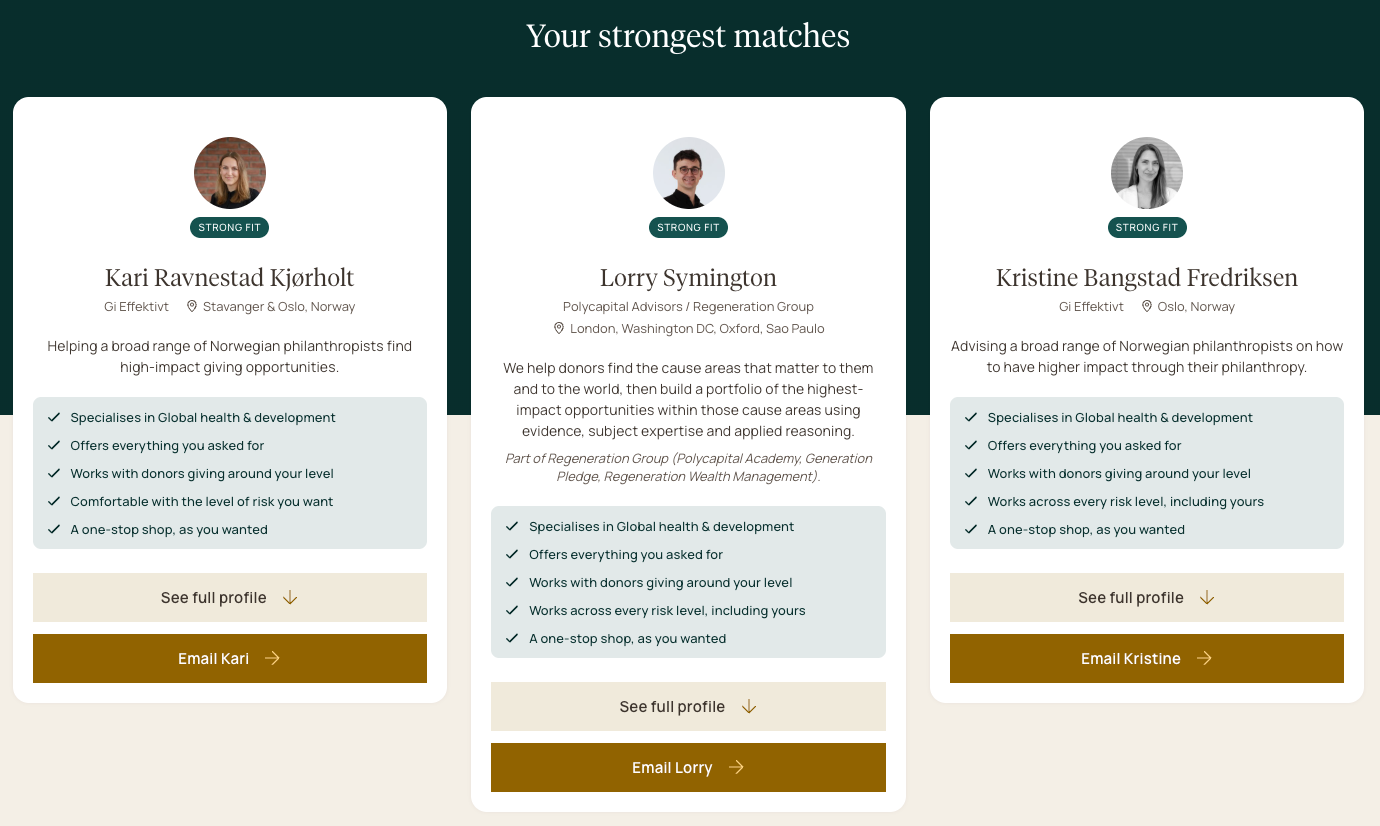
You can then view their profiles, see which advisors didn’t match and why, and change your answers to try different combinations.
Is the advisor-matching tool biased towards Ultra Philanthropy?
No.
There are clearly conflicts of interest, because I built it and my wife and I are listed as options, and I know almost all the advisors in the tool personally (Chloe and I co-authored a post just last week).
However, we built in multiple safeguards to manage these potential conflicts:
Everyone is scored by the same rules, including Ultra Philanthropy;
There’s no bonus, floor or tie-break that favours Ultra Philanthropy;
Nobody pays a listing or referral fee;
If there is no strong fit, the tool says so, rather than pushing a weak match or defaulting to Ultra;
It lists multiple strong fits where they exist, to avoid pushing a particular match too strongly;
The full method is public at matching.ultraphilanthropy.org/#how
Before launch, exact ties in scoring were settled by the order of rows in our advisor spreadsheet, where my entry happened to sit near the top. When we simulated 20,000 sets of donor answers, my entry won 263 of those ties, when its fair share would have been 131. Tied scores are now arbitrarily ordered based on the donor’s full set of answers, which is effectively a coin toss. As a result, my entry now wins exactly its fair share.
Despite the above, donors should be aware that I have influenced who is in the tool overall. The only ways to be listed are if I know your work firsthand, or if you pass the reference process below. Within this constraint, however, the scoring is as neutral as I could make it.
How do advisors get listed?
There are two routes.
If I have seen their work with major donors firsthand and rate its quality and approach, I will include them if they want to be involved.
If I haven’t, they need two written references from donors giving $100k or more a year who’ve worked with them end to end for at least six months. From today, new applicants also send a cost-effectiveness analysis of a grantee, with the model, or, where formal CEAs are rare, a grant write-up showing how they weighed the evidence. You can see more about this process here.
How do I use the advisor-matching tool?
If you are a donor looking for an advisor, please try the advisor-matching tool. If the results aren’t what you hoped for or expected, or if you have other feedback, tell me. We have already made valuable changes based on donor suggestions.
As your money starts to become real, make your philanthropic plans real as well. This period is an incredible opportunity to do good, and I believe great advice will make that impact even greater.
Jack Lewars is the founder of Ultra Philanthropy, an independent advisory that helps major donors give for maximum impact, and is the fund manager of its Mid-Stage Global Health Fund. He advises donors giving up to nine figures a year, and is Chair of Trustees at High Impact Athletes. Talk to him about your giving.
I also used Claude to help structure my thoughts and to suggest improvements and gaps, as well as for proofreading; all views, primary drafting and final edits are mine.